
One of the strongest attributes to the Salt Water New England culture is independence. Fierce independence.

One of the strongest attributes to the Salt Water New England culture is independence. Fierce independence.
.jpg) |
| Me, wearing my mother's Burberry (then Burberrys) trench coat, when I was about twenty. Photo by my father. |
I hate the notion of excessive storage. My attic and basement are nearly empty, and drawers are kept to a minimum. The youthful urge to fill has abated, and I find wide, empty surfaces the greatest luxury. Unfilled shelves represent opportunity, not signs of some intellectual wanness. I am always culling.
But sentimental items can make me tap the brakes on what is otherwise a smooth process and punt the decision.
My parents bought high quality clothing and so decisions around those items often go unresolved. I still have my mother's Burberry trench, in good condition, but a bit tight around the shoulders. So there it hangs, punted again.
My questions for the community are:
What items do you keep for sentimental reasons?
When such items are authentic, do you risk getting them tailored?
How do you dispose of "classic" items when/if it is time?
The invitations always follow the same format. "Let's meet at [some expensive restaurant/resort] at 7:15 pm on Friday night. I will make reservations. [Some person you want to see] is coming as well, and I will see if [other person] and [other person] can make it."
Or join me at The University Club or some opening night performance, try out the new guest wing, see my new house on the island, have lunch at the yacht club, or take the new (old) 380SL for a spin.
And, it does not need to be said, that friend will insist on picking up the tab.
These are checkbook friends. They are generous to a fault. Some even pick up air fare and book blocks of hotel rooms. They have vast social networks. But every event, and in fact every conversation, is on their terms.
These checkbook friends are always charming (often self-deprecating, describing themselves as "cranky" or "bossy"). They are genuinely valued friends. And tremendous fun.
And these relationships have their golden time, even if they eventually wind down.
Offering to go Dutch seems like a solution, but trying to pull it off gets resentful glances. Suggesting gatherings that don't involve bills also seems like a good idea but does not alter the trajectory of the more sponsored events.
For many young people, having an older check-book friend (or relative) can be highly influential.
 |
| Photo by Salt Water New England |
The New England prep school headmaster's walk is immediately identifiable. When walking from office to dining hall, for example, it combines two elements.
The first is surveying the quad. What is the mood? Is there a productive hum or is there a pervasive dourness? By the third week of school, the headmaster has deliberately memorized the names of all the students, and is getting a feel for individual temperaments. Likely the headmaster will make two or three engaging and knowing comments on the five minute trek.
The second is the stoop. The headmaster habitually looks for scraps of paper or other debris to scoop down upon and pick up. By the time the headmaster reaches the dining hall, there is a handful ready for depositing in the proper receptacle by the entrance.
And this is done every step of every day during the headmaster's reign.
Here is a Gorey musing of how economics, technology, social media, and customer behaviors can kill any great product.
To wit, Barbour jackets:
A is for America's market, not Britain's
B is for Brand creep: wallets and mittens
C is for Chairman and payout, the max
D is for "Designed now so no need to wax"
E is for Emmys, worn there as an item
F is for Fire, a fast way to dry 'em
G is for "Growth!" on employee screen savers
H is for Heirs who are pro sports team cravers
I is for Ironic: high heels and no liners
J is for Joint venture with hip designers
K is for Knock-offs at Penney's and Sears
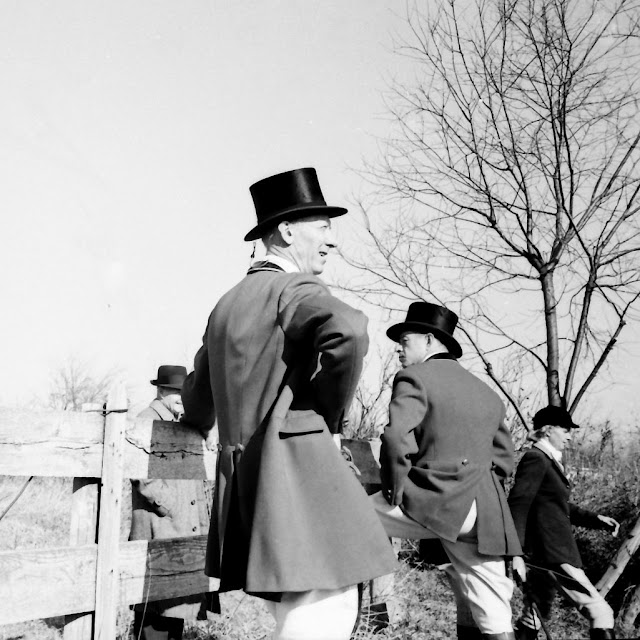 |
| The Thing Before Preppy - Photos by My Father |
One of the most defining characteristics of this "Before Preppy" culture is the concept of Class-Feral.
Sailing may be the most Class-Feral of sports. White sails, teak decks, and rough seas. Hunting (fox, not deer, obviously) also comes to mind.
Class-Feral is doing chores, taking solitary walks, even experiments in the same outfits as a trip to the club or meeting with the accountant, albeit in older and more tatty versions.
Pragmatically, Class-Feral clothes last forever. The construction endures, but even more so the styles.
Of course, beyond the superficial is where Class-Feral is more important. Stewardship and urbane intelligence meet a physicality, intrepidness, and even manic mad-scientistness.
Class-Feral can be seen when dogmatically following an internal honor code while chaffing at external rules. It is squirming miserably in a classroom but teaching oneself a new language by reading a few French novels with a dictionary. This is our Cartesian dualism.
A Class-Feral perspective views both rustic and foppish as anathema. Holes in the elbows, yes, stains, no. Overly pressed shirts and camouflage anything are two sides of the same coin.
Houses are never decorated, and in fact seldom finished at all. Old oriental rugs nicely hide the traffic from dogs, cats, chickens, and horses.
Some will recall Mr. Z.'s Darien Sport Shop with the suits on the first floor and the skis and tennis racquets on the second. Two much more common touchstones of Class-Feral are the archetypes of James Bond and Dr. Who, due in no small part to to the imprint of the Scottish actors that helped popularize them. But most leading men and women are written and directed to exhibit some form of Class-Feral, even if clumsily executed. (The United States currently has trouble with the Class-Feral concept, which has perhaps increased as schools have grown ever more uncomfortable with both Class and Feral. This may be why Hollywood has to import so many of our leading men and women.)
As with so many things, explaining it to anyone outside the world is to invite misinterpretations and ham-fisted implementations. But for those trying to understand why today's "fussy preppy," "trashy preppy," or "empty suit styles" have veered so far from The Thing Before Preppy, it explains a lot.
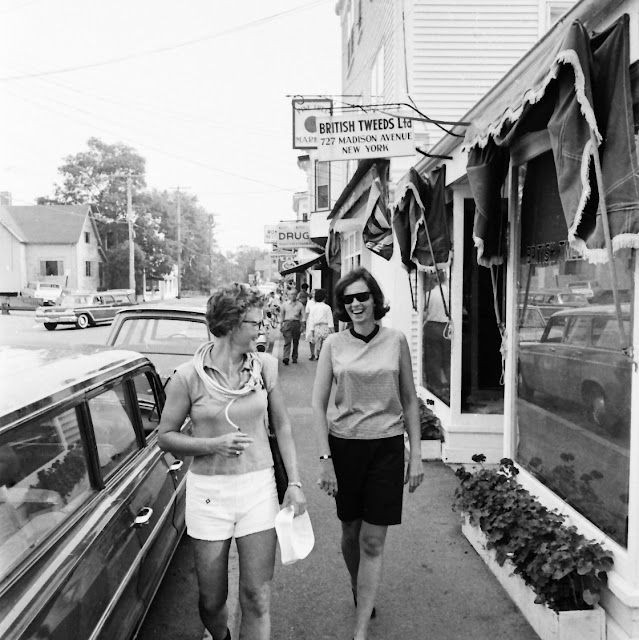 |
| Photo by My Father - Northeast Harbor, Maine |
Looking over the photographs from certain clothing companies, you may see a pattern. Brightly attired people are bounding at a tennis club or outdoor tailgating banquet or other aspirational setting, grinning ear to ear because they are having so much fun, while some animal looks on.
These are derivative of Tommy Hilfiger’s “Meet the Hilfigers" advertisements from the 90s, which themselves were riffs on the earlier Ralph Lauren campaigns of the 80s, that were based on the work of Slim Aarons.
It seems inevitable that people today associate these increasingly ersatz marketing campaigns as the definition of preppy style. Newcomers must see this as the sartorial equivalent of costume jewelry, soulless and flashy.
My take is a bit different.
For me, the origin of the style is in the 1950s, around the coast of Connecticut. A culture was codifying influenced by the wealth and access of New York; strong schools; and the culture of so many early settled New England towns with deep British roots. The clothes were often bright and casual but still substantive and well made, much of which came directly from nearby manufacturers. Towns also had shops that specialized in imported Irish woollens and tweed.
This style was immortalized in many classic New Yorker covers that were done under the art direction of James Geraghty.
Heading up the coast, New Haven soon fully embraced a variation of this, and of course so did the Boston area. The parents of prep school students bought locally-made leather shoes, Camp Mocs and Bluchers that were manufactured in Maine on the way home from summer camp.
I grew up around New Haven in the 1970s as my parents had the generation earlier. (Three of my direct ancestors were amongst the original settlers of New Haven in 1638.) It was a region and culture that raised the game of a lot of people. Obviously we never labelled our culture growing up.
This look was eventually knocked off and mass marketed, to mixed degrees of accuracy, by the preppy books of the early 1980s. It became conflated with Slim Aarons (via Ralph Lauren). At its most dreary, preppy has become completely derivative and even interchangeable with some touristy Americana.
This may be why I think of my background (and what I explore here) less as preppy, and more as “the thing before preppy.”
And to those generations that have imprinted upon these newest social media images, my culture may be even more remote, perhaps the thing before “the thing before preppy.”
I do wonder as the zeitgeist tires of these ever more cheap and vulgar variants, when misdirection goes out of style and the maneuvers of social competition are understood to be self-defeating, then perhaps the older Geraghty vision will become a better source than Aarons/Lauren/Hilfiger.
If that is the case, perhaps the thing before the thing before preppy might actually be the thing after preppy.
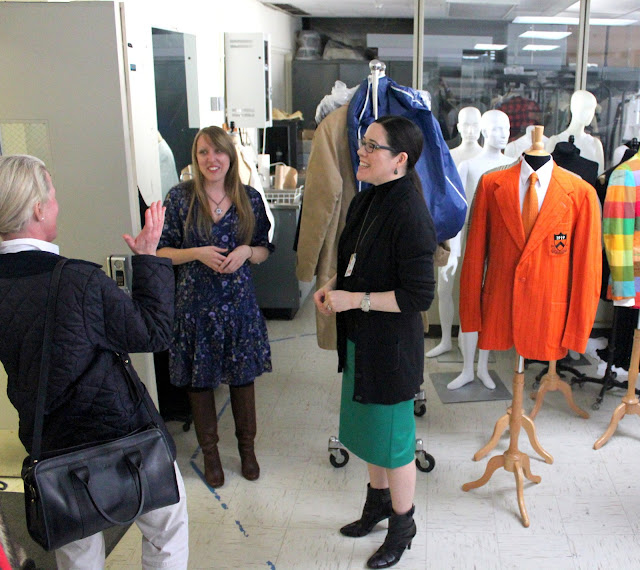
Photographs from our Archives (all but the last taken at the Westport Historical Society's Exhibit):
Note: I am going to have to spend hours today issuing copyright take-down orders to protect my intellectual property from people who illegally procured it. Many are to US based individuals who continue to take my photographs and text and pass it off as their own. Given that, here is some of what I have learned. (The following is satire, of course!)
A lot of people want to be seen as experts in the area of classic clothes but don’t have any actual expertise. Thanks to social media, this is no longer a problem. For them, the easiest way is to steal the photographs of strangers. Sure, this is illegal, but let’s be real, fines and jail time are few and far between. Why take photographs when you can take photographs? Here are a few tips for running your own kleptographer site:
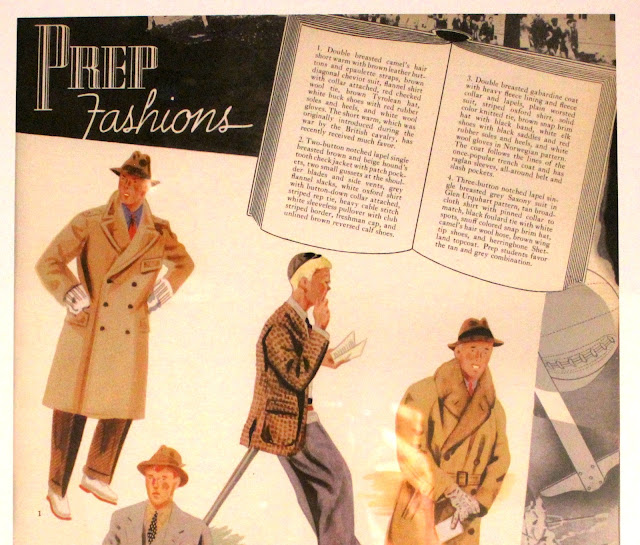 |
| Photo taken by Salt Water New England at Fashion Institute of Technology. |
Preppy: People who graduated from New England prep schools in the 20th Century and live(d) in general accordance to the ethos these schools represented.
The further (and farther) one strays from this, the weaker the provenance. When coming across the term "Preppy" in mass or social media, it mostly means "Preppy-style" which, usually can be thought of as, "Not-preppy-at-all." Preppy-style is a derivative version of a Westport to Boston aesthetic of the 1950s through the 1970s (See The Thing Before Preppy), but also reflects fashion trends, self-parody, and the aspirations of other cultures.
One secret to an interesting life is to always have a current research agenda or two.
These are big questions that we try to answer through active experimentation with real feedback. In this areas we are willing to take risks and make mistakes to calibrate, prove, or disprove ideas. (In most areas of our life, if we are not getting better, we are getting worse. Entropy beats equilibrium.)
My social media artifacts follow one of my research agendas. What does a great wardrobe look like today?
To wit, are the pressures towards wasteful trendiness and firing skilled, domestic workers inevitable? Which are the companies that are making clothes and accessories that improve with age, rather than fill landfills? How can classic clothes feel current and relevant today?
My husband and I share research agendas, and our bigger research agenda is around education. Why does the current approach feel so wrong? What might better models look? (Mission)
One artifact of our journey is the book Unschooling Rules. Charles Koch (Foundation), in his newest book Believe in People (Amazon) listed Unschooling Rules as one of his most influential.
 |
| From Charles Koch's Book Believe in People |
Our research agendas inevitably align us with fellow travelers from diverse backgrounds.
Everyone's research agenda should be different. Most agendas are temporary, but they can take decades. Where we are less passionate or skilled, it is wonderful fun to draft off of the research agendas of others. And a note of caution on process: I have found that those people who aggregate and curate the works of others often do so under the guise of a research agenda, but rather than drive growth and progress they more often accomplish the opposite. Avoid this trap.
Ideally, all of these goals are towards improving the human condition. These puts all of us in the best company.
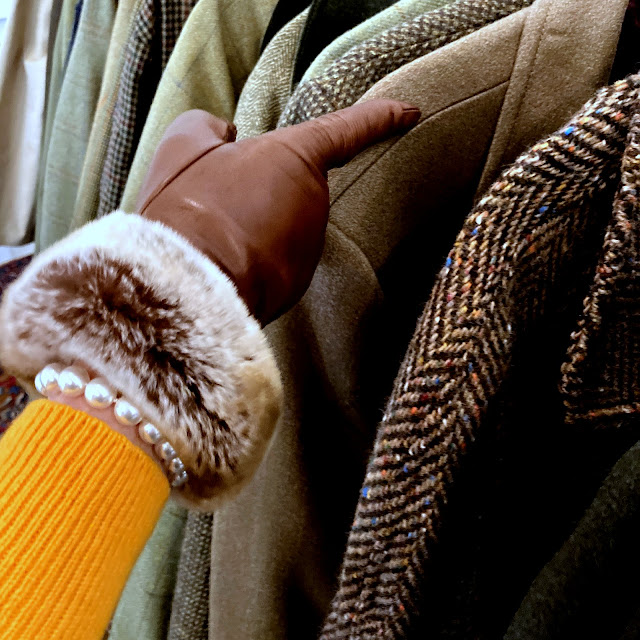 |
| Photo by Salt Water New England |
You are heading out the door. It is a bit chilly so you reach for a sweater. You have to make a split second choice between your favorite sweater or something less precious. Which do you take?
Far too many of us far too often reach for the lesser item. We want to save the best examples.
This is, most of the time, wrong.
Wearing an item is a great way of testing it. You think you like something? See if you are right. You may find that you don’t like it as much as you thought. Some items we love in theory, even how other people wear them, but they just don’t work on us. It is also a way of evolving your tastes. You want to learn from experience to make your next purchase more intelligently.
And clothes are not always like fine wines or a great scotch. If you are not wearing an item, it seldom gets better with age.
The items we love and don’t wear today end up clogging up the closet within a few years. Pretty soon we can’t give them away. In other words, the rule of thumb that you should get rid of clothes you haven’t worn in one to three years is true. (Society is more interested in listening to thoughts on cleaning than on clothes but the message here is the same.)
I do have a few exceptions. When I find clothes I really like, I tend to do some gentle stockpiling, especially if they go on sale. I have backups, and backups of backups, of various shirts and trousers that I currently wear.
And I do have a handknit Aran clan sweater still in its box, but even now I am thinking I should just wear it.
The truth is that we change. Our tastes evolve. We find better or alternative examples. We more comprehensively understand what works well with what we want to do. We move. Our hobbies change. Our bodies change, even if they don’t get thicker. Our skin tone and hair color changes.
So wear what you love. Take pleasure in getting every stitch of value from it, not in archiving it. It will improve your world in more ways than you think.
 |
| Photo by Salt Water New England |
It is accepted that some people love food. And some people love music. Other people love architecture. Or technology. Or sports. Or watching films.
For each of these, we can read reviews, listen to podcasts, and engage in easy conversations with strangers. Ranking and other comparisons ("top five films about artificial intelligence", "ten best Beethoven sonatas) are the staple of cottage industries.
But to love clothes is more often seen as problematic. One is seen as too vain, or class conscious, or wasteful. More to the point, perhaps, to love clothes out in the open. Few myths are as apocryphal as the person who doesn't care about clothes.
Spending a generous birthday chit on a big dinner garners nods of appreciations, but on a sought after coat brings out everyone's inner Spartan. It might as well be January third and everyone just wants to get back to work. Perhaps the only socially forgivable largesse in clothing expenditures is for something extravagantly "fun" or "for style" and done on a lark.
Attempting serious conversations about clothes also chills any mood. Many who are otherwise doing their bit for the environment and supporting living wages often have blind spots when buying clothes made in sweat shops. To them, Patagonia is a role model, despite their off-shoring and synthetics.
The cost of this attitude has been high. Many clothing companies, certainly in the U.S., have enjoyed our social discomfort by relentlessly lowering standards and raising prices. Few companies here strive for greatness beyond marketing.
I wonder how much it is a U.S. thing. It has been said that American actors work from the heart out, while British actors work from the clothes in. Laurence Olivier once said he understood a role when he could figure out what shoes the character would wear.
Having said that, I do have hope. The truth is that it is great to love clothes. I would rather savor a good tweed than a good bottle of wine. Every walk, at least now that summer is over, begins with the decision of which wonderful outer garment to wear. My temperament is such that short bursts of vacation feels unsatisfying, like trying to hold onto sand, while something that endures gives me pleasure in getting it, in wearing it, and finally in passing it on.
And more people are finally catching on to the nasty business that we call fashion.
So perhaps someday more people will, among friends, casually debate top five light jackets, or favorite materials for commuter coats, or best new clothes of a given year.
Until then, it remains a more quiet love, and perhaps more pure as a result.


